Bridging the AI frontier: A guide to AI inventions in Singapore and Canada


Co-authored by Mark J. Springings – Gowling WLG
Canada and Singapore rank among the world’s leading AI research and commercialisation hubs. Canada’s strength lies in its academic ecosystem, the Vector Institute, Mila, and AMII, supported by the Pan-Canadian Artificial Intelligence Strategy. Its proximity to the United States, the world’s largest technology market, makes Canada a natural gateway for companies seeking North American patent coverage. Singapore, meanwhile, has emerged as southeast Asia’s primary gateway for AI development, driven by its National AI Strategy (NAIS 2.0) and the Intellectual Property Office of Singapore (IPOS).
For patent counsel managing cross-border portfolios, securing AI-related intellectual property in these two jurisdictions requires navigating distinct statutory frameworks, differing examination practices for Computer-Implemented Inventions (CII), and contrasting prosecution timelines.
This article provides a comparative analysis of Singapore (IPOS) and Canada (CIPO) patent landscapes, offering actionable drafting and prosecution strategies for maximising portfolio value in both jurisdictions.
AI inventorship battleground
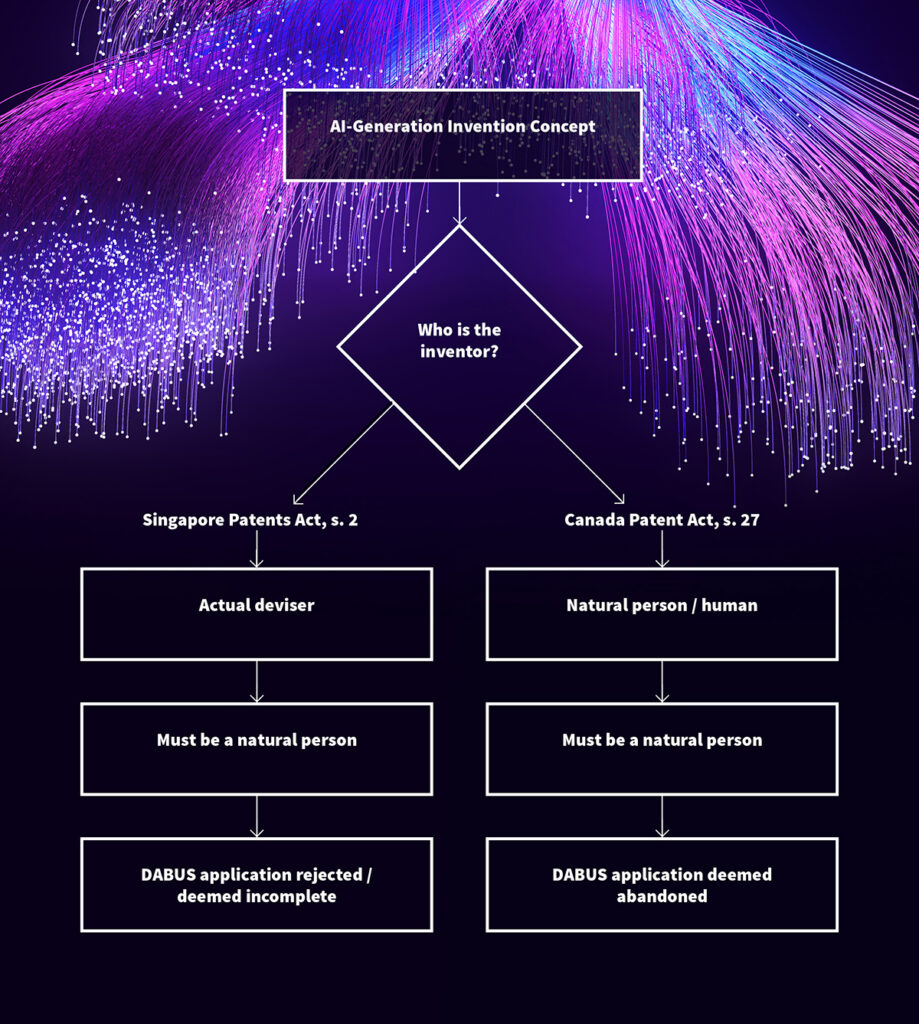
The global debate over whether an AI system can be named as an inventor – such as Stephen Thaler’s DABUS – has met consistent resistance in both Canada and Singapore, though the underlying legal bases and administrative processes differ as the following flowchart depicts.
The Singapore position (IPOS)
Under Section 2(1) of the Singapore Patents Act, an “inventor” is defined as the “actual deviser of the invention.”
- Legal stance: IPOS has aligned with international consensus, maintaining that the “actual deviser” must be a natural person. An AI machine lacks legal personality and cannot hold or transfer patent rights.
- Practical practice: If an application names an AI as the inventor, IPOS will issue a registry objection. To overcome this, counsel must identify the human engineers who configured the AI’s parameters, designed the training datasets, or verified the AI’s output as the true inventors.
The Canadian position (CIPO)
Under the Canadian Patent Act (R.S.C., 1985, c. P-4) and Patent Rules (SOR/2019-251), the term “inventor” is not expressly defined as a “natural person.”
However, the requirement that an inventor be human derives from the common law understanding that ‘devising’ an invention presupposes human mental activity. CIPO’s administrative position, rather than binding judicial precedent, currently governs this area.
- Legal stance: In the Canadian prosecution of the DABUS application (CA 3,137,029), CIPO took the position that under Canadian law, the inventor must be a human being capable of exercising the mental faculties necessary to devise an invention. Because the applicant named an AI system as the sole inventor, CIPO issued a requisition that ultimately led to the application being refused. It’s worth noting, the precise procedural outcome, whether formally ‘refused’ or ‘abandoned’ for failure to comply, should be verified against official CIPO records, as these are distinct outcomes under the Patent Rules.
- Practical practice: Under Canadian practice, the applicant must provide the names of the inventors pursuant to Rule 36 of the Patent Rules. Unlike in the US, Canada does not require a formal inventor’s oath or declaration. The chain of title from inventor to applicant is established through assignments or employment agreements. CIPO will refuse any application where the chain of title cannot be traced back to a human inventor, as an AI cannot legally hold or assign patent rights.
Patent eligibility of AI and computer-implemented inventions (CII)
Both jurisdictions reject AI as an inventor, but they diverge sharply on the patent eligibility of AI software itself regarding machine learning models, neural network architectures, and training methods.
Singapore’s pragmatic ‘Invention-as-a-Whole‘ approach
IPOS is highly receptive to software and AI patents, utilizing a holistic framework that mirrors the European Patent Office (EPO) but is possibly applied more flexibly.
- The test: To be patentable, an AI invention must make a ‘technical contribution’ or solve a technical problem with a technical solution.
- Software friendliness: IPOS does not categorically exclude computer programs. If an AI algorithm is integrated into a physical process, improves the internal functioning of a computer such as faster processing, better memory allocation, processing real-world physical data, analysing medical images or seismic data, then it is considered patent eligible.
- Drafting tip for practitioners: Focus the specification on the technical utility. Describe how the AI model optimises database queries, reduces network latency, or improves hardware efficiency.
Canada’s complex Purposive Construction and the Choueifaty framework
Canada has historically been a difficult jurisdiction for computer-implemented inventions. CIPO’s former problem-solution approach often stripped software steps out of claims. The Federal Court’s decision in Choueifaty v Attorney General of Canada, 2020 FC 837, forced CIPO to change course.
- Post-Choueifaty test: Following the Federal Court’s decision in Choueifaty v. Attorney General of Canada, 2020 FC 837, CIPO revised its approach to computer-implemented inventions. CIPO now applies ‘purposive construction’ in accordance with the Supreme Court of Canada’s precedents (Free World Trust v Électro Santé Inc., 2000 SCC 66; Whirlpool Corp. v Camco Inc., 2000 SCC 67). The examiner identifies the ‘essential elements’ of the claims as construed by the skilled person. If the computer or AI algorithm is an essential element of the claim, the question is whether the claim as a whole defines patentable subject matter under s. 2 of the Patent Act – an ‘art, process, machine, manufacture or composition of matter’ – and does not fall within the exclusion for ‘mere scientific principles or abstract theorems’ under s. 27(8).
- Mere Scientific Principle: Section 27(8) of the Canadian Patent Act prohibits patenting ‘mere scientific principles or abstract theorems.’ CIPO may object to AI applications by characterizing machine learning algorithms as abstract mathematical methods. However, under CIPO’s post-Choueifaty guidance, examiners assess whether the claims as a whole, when purposively construed, amount to only an abstract theorem or scientific principle. A claim that applies a mathematical method to achieve a practical result may still be patentable.
- Drafting tip: To survive a CIPO examination, claims must tightly couple the AI algorithm with a physical system or practical application. For example, instead of claiming ‘a machine learning model that classifies data,’ claim ‘a computer-implemented method for controlling an industrial manufacturing robot using a neural network trained on sensor data.’
Head-to-head comparison
The table below outlines the critical operational and legal differences patent counsel must consider when coordinating filings in Singapore and Canada.
| Feature / metric | Singapore (IPOS) | Canada (CIPO) |
| Primary statutory hurdle | Technical contribution requirement (CII Guidelines). | Section 2 (definition of “invention”) and Section 27(8) Patent Act (exclusion of abstract theorems). |
| Inventorship standard | “Actual deviser” (Natural person only). | Natural person only (DABUS application rejected). |
| Drafting focus | Technical effect and solving a technical problem. | Purposive construction; coupling software with physical systems. |
| Prosecution speed | Possibly fast: SG IP FAST program can grant patents in as little as 6 months. | Moderate to slow: Standard prosecution typically takes 2–5 years, depending on technology area. |
| Acceleration options | SG IP FAST, ASPIRE, Patent Prosecution Highway (PPH). | Patent Prosecution Highway (PPH), Advance Examination. |
| Software patent friendliness | High: Highly predictable and software-friendly examination guidelines. | Moderate: There is scrutiny of abstract algorithms and requires updated case law. |
| Grace period | 12-month public disclosure grace period. | 12-month grace period for disclosures made directly or indirectly by the applicant (or someone who obtained information from the applicant) before the filing date. |
Strategic prosecution playbook for cross-border portfolios
For counsel managing an AI-driven patent portfolio spanning both regions, they may wish to consider the following filing strategy once the patent specification has been drafted, since Singapore and Canada participate in a bilateral PPH agreement.
- Consider filing in Singapore and expediting prosecution proceedings.
- Leverage the PPH to accelerate a corresponding Canadian application (this approach also provides a more predictable outcome).
To satisfy both IPOS’s ‘technical contribution’ standard and CIPO’s ‘purposive construction’ rules, use a tiered claim strategy in applications.
- Base layer (for Canada): Ensure there are claims that explicitly integrate the AI model with physical hardware, specific inputs – raw sensor data, real-world images, and tangible outputs such as mechanical actions, concrete physical parameter adjustments.
- Optimisation layer (for Singapore): Include claims focused on the algorithmic efficiency of the AI itself – unique neural network layers, weight adjustment techniques, or data pipeline structures – to capture broad protection for the core software IP.
For Canadian tech companies tapping Singapore’s talent pool, and vice versa, employment contracts and consulting agreements should explicitly define ownership of AI-assisted outputs and include pre-signed assignment clauses. This keeps the human-inventor assignment chain legally airtight from day one.
Companies with US market ambitions should also consider Canada’s role as a North American gateway. For instance, a Canadian patent, combined with a US filing, provides integrated continental coverage, and prosecution work product from CIPO can be leveraged under the Canada-US PPH to accelerate USPTO examination.
Conclusion
Canada and Singapore both require human inventorship, but they diverge sharply on how they evaluate the patentability of AI software. Singapore offers a fast, predictable pathway for securing software patents; its SG IP FAST programme can deliver a grant in as little as six months, making it an ideal launchpad for global AI portfolios.
Singapore’s software-friendly examination guidelines and its role as a gateway to ASEAN markets add further strategic value for companies expanding across Asia-Pacific. Canada, with its significant AI market and direct access to the United States, serves as a complementary gateway for North American patent coverage. The shared border, integrated supply chains, and USMCA framework make Canadian patent protection a natural complement to any US filing strategy.
That said, Canada demands careful claim drafting that integrates software with practical applications, and tactical use of prosecution tools like the PPH to meet the legal requirements for patent eligibility under the Patent Act.
Together, Singapore and Canada offer a powerful combination – Singapore provides speed, predictability, and access to Southeast Asian markets, while Canada provides depth, North American reach, and a springboard into the US.
A dual-compliant drafting strategy, combined with Singapore’s fast-track system to pull Canadian applications forward via the bilateral PPH, lets patent counsel build a formidable IP position across both economies. For companies with US market ambitions, a Canadian patent adds continental coverage at lower cost than a US filing alone, while the Canada-US PPH provides a further acceleration pathway into the USPTO.
Contact the authors or a member of Gowling WLG’s Patent team if you have any questions.